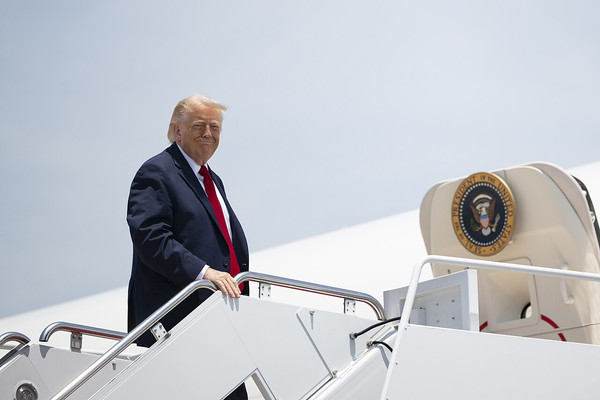
President Donald Trump indicated Tuesday that he is open to sending his administration’s newly signed agreement aimed at ending the conflict with Iran and opening nuclear discussions with Tehran to Congress for formal review, a move that could provide lawmakers their first opportunity to examine the still-unreleased framework.
Speaking during a bilateral meeting with United Arab Emirates President Sheikh Mohamed bin Zayed Al Nahyan, Trump was asked whether he would submit the agreement to Congress for approval.
“I wouldn’t mind,” the president responded.
Trump then joked about congressional Democrats, suggesting that political opposition often works in his favor.
“I mean, you know, the Democrats – we call them Dumocrats because they’re dumb people,” Trump said. “The Democrats are… Well what I’d like to do is send it to Congress, saying you shouldn’t approve it, and I’ll get it approved, whatever they, whatever I say, they want to do the opposite. It’s not working too well for them, by the way.”
The president acknowledged that he had not previously considered the possibility but appeared to embrace the idea during the exchange.
“But yeah, I never thought about sending, never even thought about it, but I will. I will send it to Congress,” Trump said. “I like the idea.”
The comments come as questions continue to swirl around the memorandum of understanding signed Sunday by both Trump and Vice President JD Vance. While administration officials have described the agreement as a framework for ending the war and beginning a new phase of discussions with Tehran, the text itself has not yet been made public.
The lack of public details has fueled both speculation and criticism from observers seeking more information about the arrangement. At the same time, the announcement appeared to boost investor confidence, with stock prices rising Monday following news of the agreement.
Throughout the negotiations, the Trump administration has consistently argued that Iran has provided assurances it will not obtain a nuclear weapon. Senior administration officials reiterated Monday that no funds would be released to Iran unless Tehran fulfills commitments outlined in the agreement.
At the center of much of the debate is reported discussion of a broader effort to rehabilitate and economically develop Iran. Reports have suggested the package could involve as much as $300 billion in financing, although it remains unclear where such funding would originate.
Trump has stated that the money would not come from the United States.
On Capitol Hill, many Republican senators have taken a cautious approach, saying they need to review the agreement before offering firm judgments. While several lawmakers have expressed support for Trump’s broader objectives, they have also emphasized the need for transparency regarding the terms.
Among them is Sen. Lindsey Graham of South Carolina, one of Trump’s strongest allies in the Senate and a supporter of the president’s decision to launch Operation Epic Fury.
“The MOU, I want to see it myself,” Graham said. “The way Iran describes it is awful. The way we describe it makes sense to me. Let’s look at it and see what it actually is.”
The debate also raises questions about congressional oversight. In 2015, lawmakers passed the Iran Nuclear Agreement Review Act, giving Congress a formal role in reviewing nuclear-related agreements with Tehran.
Under that law, any agreement with Iran must be submitted to Congress within five days of being reached. Once received, lawmakers have a 30-day period to consider the arrangement and vote on a resolution disapproving it.
As discussion continues, both supporters and skeptics appear united on at least one point: before Congress can make a decision, lawmakers first want to see exactly what is in the deal.
Trump Signals Iran Agreement Could Head to Congress as Lawmakers Seek Details on Unreleased Deal
- by:
- 06.16.20
- Source:
nightlynewslink.com

- 06.16.20
