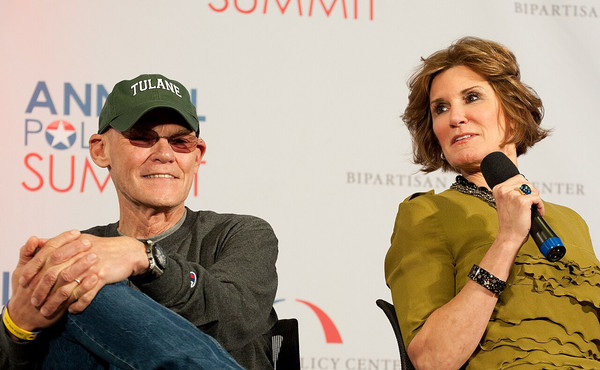
Democratic strategist James Carville dismissed what he described as excessive enthusiasm over Michigan Democratic Senate nominee Abdul El-Sayed’s primary victory, cautioning fellow Democrats against embracing what he characterized as a political “revolution” before the party has won a general election.
Carville made the remarks during a Friday appearance on CNN News Central, where he sparred with anchor Brianna Keilar over whether recent primary victories by progressive candidates signal a broader shift within the Democratic Party.
El-Sayed secured the Democratic nomination for Michigan’s open U.S. Senate seat earlier this week after narrowly defeating Rep. Haley Stevens, who had been backed by several prominent establishment Democrats. The victory sets up a general election contest against Republican Mike Rogers in November.
Although El-Sayed has said he is not a democratic socialist, his campaign received support from prominent members of the Democratic Socialists of America (DSA), and his victory has been viewed by some observers as part of a series of successful campaigns by left-leaning Democratic candidates.
During Friday’s discussion, Keilar pointed to those recent primary results as evidence of what she described as a growing populist movement within the Democratic Party.
She also noted that candidates supported by Senate Minority Leader Chuck Schumer had fallen short in several major primaries, including Michigan, before asking Carville whether the Democratic establishment still maintained a strong hold over the party’s voters.
Carville rejected the notion that El-Sayed’s victory represented a sweeping political realignment, arguing that the reaction to the result had been exaggerated.
“I don’t know, and I don’t know if Democratic voters are looking for that,” Carville said before removing his hat during the interview.
“You got 48% in a primary, you’re being hailed on CNN as revolutionary, complete tidal wave hitting the United States, it’s the latest greatest thing that ever happened,” he continued.
Carville urged caution in interpreting the outcome, saying analysts should avoid drawing broad conclusions from a single primary contest.
“And what I’m saying here is, I would go a little bit slow maybe if I was analyzing this,” he said.
The veteran Democratic strategist also argued that primary victories alone do not guarantee success in the general election, emphasizing that nominees must unify their party after contentious campaigns.
“You’re going to have your chance in 2028, but boy, we’re all into it—we’re all into the revolution now,” Carville said. “And we’re all, ‘wow, yes, this is great, this is wonderful!’”
He went on to offer advice for El-Sayed as he prepares to face Republican nominee Mike Rogers this fall.
“You got to get everybody who voted for your opponent in the primary to vote for you in the general,” Carville said.
He suggested that accomplishing that goal will require outreach to Democrats who backed Stevens during the primary.
“Maybe you need to do some hard political work and develop some political skills that make you more accessible to more voters,” Carville added. “That’s just me off the top of my head.”
Carville concluded by reiterating that he was unconvinced El-Sayed’s victory represented a nationwide political movement.
“But excuse me for not being on the bandwagon here that this is a giant movement that is sweeping the country,” he said.
Keilar defended CNN’s discussion of the primary results, responding that the network had a responsibility to examine emerging political developments.
“You’re allowed to not be on the bandwagon,” Keilar said, “but we would be remiss to not discuss trends that we’re seeing or popular figures that we’re seeing that are having electoral success.”
The exchange highlighted an ongoing debate within Democratic circles over whether recent progressive primary victories represent isolated successes or the beginning of a broader shift in the party’s direction heading into future election cycles.
Reword
James Carville Downplays Abdul El-Sayed’s Primary Win, Urges Democrats to Focus on General Election
- by:
- 08.07.20
- Source:
nightlynewslink.com

- 08.07.20
