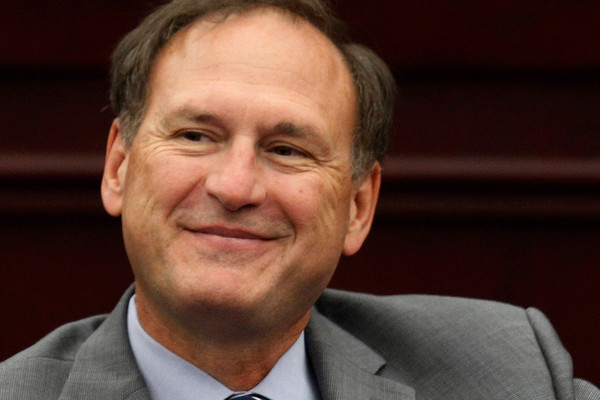
Justice Samuel Alito issued a forceful dissent Tuesday after the Supreme Court struck down the Trump administration’s effort to restrict birthright citizenship, calling the decision “one of the most important” in the court’s history while warning it would have significant consequences for the nation’s future.
In a 6-3 ruling, the Supreme Court found that an executive order signed by President Donald Trump on the first day of his second term violated the Citizenship Clause of the 14th Amendment. The constitutional provision guarantees automatic citizenship for nearly all children born on U.S. soil, regardless of their parents’ immigration or citizenship status.
The Trump administration had argued that birthright citizenship should apply only to children with at least one parent who is either a U.S. citizen or a lawful permanent resident. The administration’s executive order sought to implement that interpretation, but the court rejected the effort.
Writing in dissent, Alito sharply criticized the majority’s reasoning and argued the decision rested on an incorrect reading of the Constitution. He described the ruling as “a serious mistake” that he believes will have a lasting impact on the country.
“If the Fourteenth Amendment required these results, the country would have to live with them or amend the Constitution,” Alito wrote. “But the Fourteenth Amendment does not include the rule the Court now imposes on the country.”
“In my judgment, the Court has made a mistake that will seriously affect the country’s future,” he continued.
Alito argued that the majority relied too heavily on prior precedent rather than the actual language of the 14th Amendment. According to his dissent, the court’s analysis “glosses the text” of the Citizenship Clause and “fails on textualist grounds.”
A central focus of Alito’s argument involved the amendment’s requirement that those granted citizenship be “subject to the jurisdiction” of the United States. He contended the majority failed to adequately consider the issue of dual nationality for children born to parents who are in the country illegally.
“A great many persons who are born here to illegal immigrant parents fail this test because at birth they are automatically made nationals of their parents’ native country and, as a result, incur duties to that country,” Alito wrote. “This means that they are ‘subject to a foreign power’ and are thus not ‘subject to the jurisdiction’ of the United States within the meaning of the Fourteenth Amendment.”
Alito also warned that the court’s interpretation could encourage “birth tourism,” the practice of pregnant foreign nationals traveling to the United States so their children can obtain American citizenship at birth. He said the ruling could produce what he described as “grotesque results” and also raised concerns about possible national security implications.
“Careful analysis of the text of the Fourteenth Amendment and the process that led to its adoption shows that it does not degrade the concept of United States citizenship in this way,” Alito wrote. “Instead, the Fourteenth Amendment confers citizenship on only those children who, at birth, owe allegiance solely to this country.”
The majority opinion was written by Chief Justice John Roberts and joined by Justice Amy Coney Barrett, along with the court’s three liberal justices.
Justices Clarence Thomas, Neil Gorsuch and Alito dissented from the decision. Justice Brett Kavanaugh disagreed with the court’s interpretation but nevertheless voted to block the Trump administration’s executive order under federal law.
Alito Warns Supreme Court Birthright Citizenship Ruling Will Have Lasting Consequences
- by:
- 06.30.20
- Source:
nightlynewslink.com

- 06.30.20
