



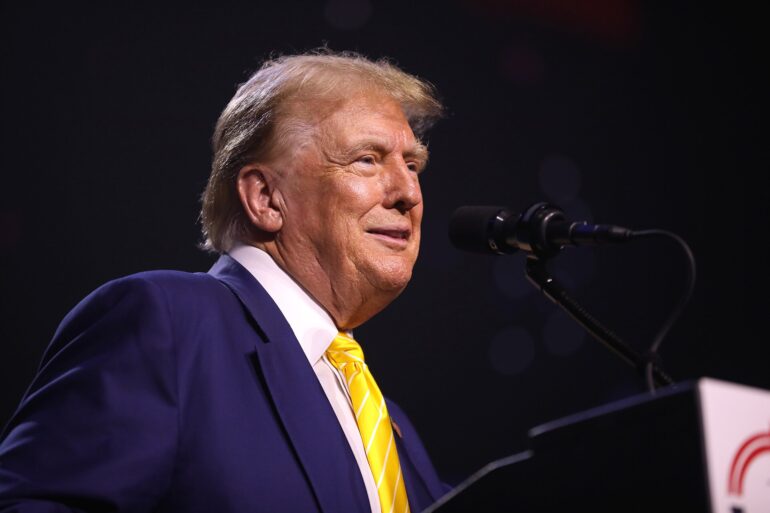
President Donald Trump made an aggressive and detailed case Wednesday at the World Economic Forum in Davos for the United States to acquire Greenland, calling for immediate negotiations and, for the first time, explicitly pledging that he would not use military force to obtain the territory. Trump framed the issue as one of national and international security, telling world leaders that American ownership of Greenland is essential to defending the West against emerging global threats.
Speaking at length, Trump acknowledged that some observers believe the United States would need to use “excessive force” to take control of the Arctic island, even suggesting that such a move would make the country “unstoppable.” But he quickly rejected that path, stressing that he has no intention of pursuing it.
“That’s probably the biggest statement I made, because people thought I would use force,” Trump said. “I don’t have to use force, I don’t want to use force. I won’t use force.”
Instead, Trump said he wants Greenland acquired through negotiations, insisting the U.S. needs full “right, title and ownership” of the territory. He argued that anything short of ownership would be inadequate for defense, dismissing the idea of leases or licensing arrangements as both legally and psychologically flawed.
“You can’t defend it on a lease,” he said. “No. 1, legally, it’s not defensible that way. Totally. And No. 2, psychologically, who the hell wants to defend a license agreement or a lease?”
Trump repeatedly described Greenland as a massive expanse of ice, but emphasized its enormous strategic value in the event of a conflict with major powers like Russia or China. He warned that in a future war, Greenland would sit directly beneath critical missile flight paths.
“Much of the action will take place on that piece of the ice,” Trump said. “Those missiles would be flying right over the center of that piece of ice.” He said the United States wants the territory so it can build what he called “the greatest golden dome ever built” to protect against hostile threats.
Earlier in his remarks, Trump dismissed Denmark’s ability to protect or develop Greenland, arguing that the United States is uniquely capable of securing the territory. He claimed there was “no sign” of Denmark on the island and accused Copenhagen of failing to spend adequately on defense.
Trump also offered a historical justification for American involvement in Greenland, pointing back to World War II. He said that after Denmark fell to Nazi Germany in a matter of hours, the United States stepped in to secure Greenland to prevent enemy forces from gaining a foothold in the Western Hemisphere.
According to Trump, American forces established bases on Greenland and held the territory at great cost, not only for U.S. security but to protect Denmark itself. He said that after the war, the United States returned Greenland to Denmark, a decision he now questioned.
“We saved Greenland,” Trump said, arguing that the U.S. prevented its enemies from occupying the island. He suggested Denmark’s current opposition to American acquisition reflects ingratitude for that history.
In a notable shift from earlier arguments, Trump downplayed Greenland’s mineral resources as a motivation. He said access to rare earth elements is not the driving factor behind his push, noting that extracting them would require drilling through hundreds of feet of ice.
“That’s not the reason we need it,” Trump said. “We need it for strategic national security and international security. It’s not important for any other reason.”
Trump’s remarks marked his most comprehensive and forceful case yet for acquiring Greenland, combining reassurances about the use of force with stark warnings about global security and America’s role in defending the West.
About Post Author

