



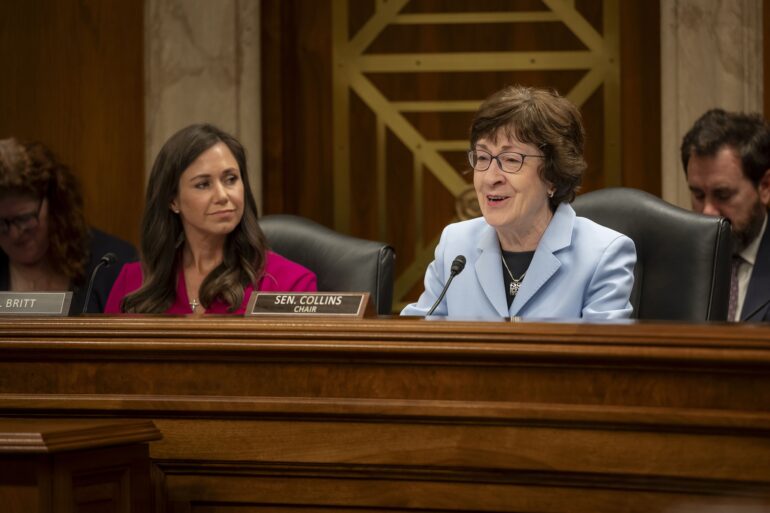
Sen. Susan Collins officially launched her campaign for a sixth term on Tuesday, setting the stage for what is expected to be one of the most closely watched and competitive Senate races in the country this November.
Collins announced her decision in a short social media video, striking a lighthearted tone as she unboxed a new pair of New Balance running shoes. “This is perfect for 2026, because I’m running,” she said, making clear she intends to stay in the fight despite the political headwinds she faces.
As the only Republican senator representing a reliably blue state, Collins has long occupied a unique position in Washington. Her centrist brand has allowed her to survive repeated Democratic challenges, including a high-profile race in 2020 that Democrats heavily targeted but ultimately failed to flip. With control of the Senate once again hanging in the balance, Democrats are eager to try again.
Collins is expected to face a formidable opponent. On the Democratic side, the race could feature Maine Gov. Janet Mills, who has the backing of Senate Minority Leader Chuck Schumer, or Graham Platner, an oyster farmer who has emerged as a progressive favorite. Either matchup is expected to be expensive, aggressive, and nationalized.
The Cook Political Report currently rates the Maine contest as a “toss up,” making it one of just two Republican-held Senate seats in that category. The other is in North Carolina, where Republicans are defending the open seat being vacated by Sen. Thom Tillis.
Democrats wasted little time attacking Collins following her announcement. The Democratic Senatorial Campaign Committee claimed in a post on X that Collins has “lost the trust of Maine voters” and predicted she would be defeated at the ballot box in November.
Collins’ announcement comes shortly after Congress approved 11 of the 12 full-year government funding bills, legislation she played a central role in advancing as chair of the Senate Appropriations Committee. Republicans privately acknowledge that keeping Collins in the race was critical, arguing that no other GOP candidate could realistically hold the seat in Maine.
Despite her legislative influence, Collins has faced political turbulence in recent months. Some of the loudest criticism has come from the White House, where President Donald Trump said in early January that she should “never be elected to office again” following her vote to restrict military force in Venezuela. The comments underscored the delicate balance Collins must maintain between independence and party unity.
Even so, Senate Republican leadership has remained firmly behind her, emphasizing political reality over internal disagreements. Senate Majority Leader John Thune made that position clear last month.
“There is one way to elect a Republican in the state of Maine, and that’s for Susan Collins to be the nominee,” Thune said.
For Republicans, Collins represents not just a candidate, but a strategy: win with a proven incumbent who has built crossover appeal in hostile territory. For Democrats, she is one of their top opportunities to expand their Senate ranks.
With the campaign now officially underway, both sides are bracing for a hard-fought battle that could help determine control of the U.S. Senate next year.
About Post Author

