


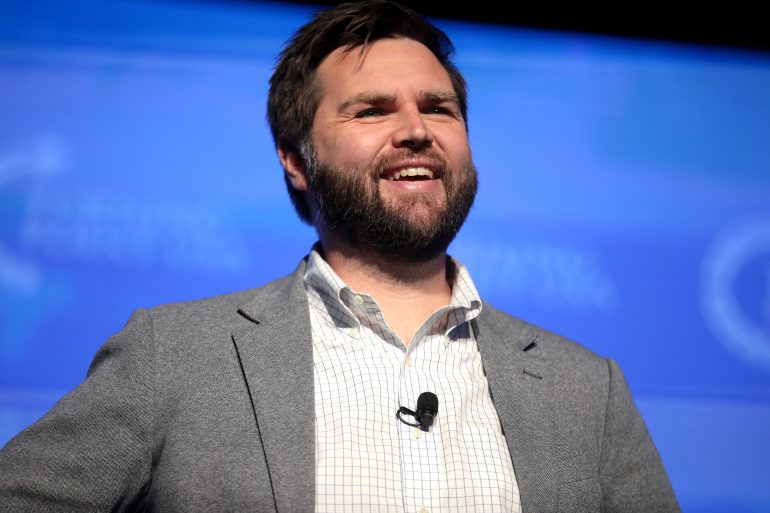
Vice President J.D. Vance sharply criticized the Supreme Court on Friday after it struck down a majority of President Donald Trump’s sweeping tariffs, accusing the justices of undermining the president’s authority to defend American industry.
“Today, the Supreme Court decided that Congress, despite giving the president the ability to ‘regulate imports’, didn’t actually mean it,” Vance wrote on the social platform X. “This is lawlessness from the Court, plain and simple. And its only effect will be to make it harder for the president to protect American industries and supply chain resiliency.”
Vance argued that the ruling would complicate efforts to strengthen domestic manufacturing and safeguard supply chains, priorities the Trump administration has repeatedly emphasized. At the same time, he noted that the president retains a “wide range of other tariff powers” that could still be used moving forward.
The decision centered on the administration’s use of the International Emergency Economic Powers Act (IEEPA) to impose steep tariffs on countries around the world. The law allows the president to regulate imports in response to what it describes as “unusual and extraordinary” threats. A majority of the Court ruled that the administration’s reliance on IEEPA in this case was improper.
Notably, two of the six justices in the majority — Amy Coney Barrett and Neil Gorsuch — were appointed by Trump. The president did not hide his frustration.
Speaking at the White House on Friday afternoon, Trump said he was “ashamed of certain members of the court.”
“I don’t want to say whether I regret nominating them. I think their decision was terrible,” Trump said. “I think it’s an embarrassment to their families.”
While Vance and Trump condemned the ruling, reaction on Capitol Hill reflected longstanding divisions over the administration’s tariff strategy. Lawmakers in both parties have raised concerns about the use of IEEPA to impose tariffs, citing Congress’s constitutional authority over taxation. Last fall, a resolution calling for the cessation of Trump’s tariffs passed in the Senate with bipartisan support.
Recent polling also suggested public skepticism. A February survey found that 67 percent of respondents supported the Supreme Court overturning the tariff policies.
Economic data has further fueled the debate. A recent report from the Federal Reserve Bank of New York indicated that U.S. businesses and consumers absorbed about 90 percent of the costs associated with the tariffs. That finding contrasts with claims from the White House that foreign countries would bear most of the financial burden.
Several prominent Republican lawmakers publicly welcomed the Court’s ruling. Kentucky Sens. Rand Paul and Mitch McConnell, both Republicans, had previously voted in favor of the Senate resolution last October aimed at halting the tariffs.
Paul, who sponsored the resolution, described the ruling as a “defense of our Republic” in a post on X.
McConnell said in a statement that the decision leaves “no room for doubt” about Congress’s constitutional role in trade policy.
“Congress’ role in trade policy, as I have warned repeatedly, is not an inconvenience to avoid,” McConnell said. “If the executive would like to enact trade policies that impact American producers and consumers, its path forward is crystal clear: convince their representatives under Article 1.”
Despite the setback, the administration signaled that it is not backing down, with Vance underscoring that other legal avenues remain available to pursue the president’s trade agenda.
About Post Author

