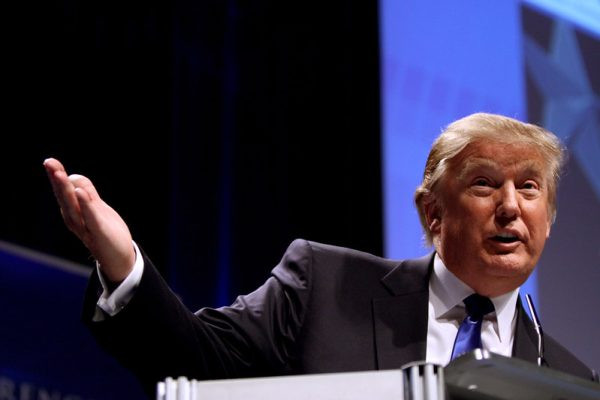
President Donald Trump is expanding his voluntary Ratepayer Protection Pledge, promising the initiative will help prevent rising electricity costs for American families as the nation experiences rapid growth in data center construction tied to artificial intelligence.
According to the Associated Press, Trump broadened the nonbinding pledge on Thursday. The agreement has now been signed by 23 governors, 55 utility companies and 27 data center companies. The White House says the pledge is designed to ensure that companies building and operating data centers pay for their own electricity-related costs instead of shifting those expenses onto residential consumers.
Speaking about the initiative, Trump expressed confidence that the plan would ultimately reduce energy costs for households across the country.
“Electricity bills for American families will actually come down,” Trump said, according to the Associated Press. “They’re going to have a lot of electricity left over, and they’ll put that into the grid.”
The White House echoed that message, arguing the pledge is intended to protect ratepayers while encouraging continued investment in AI infrastructure.
“President Trump expanded his Ratepayer Protection Pledge to governors, legislators, developers, and power providers to ensure everyone involved in building and powering data centers covers their own costs instead of passing them on to American families,” White House spokeswoman Taylor Rogers told the Daily Caller News Foundation.
Rogers also said the administration believes the initiative will strengthen local economies while boosting the nation's position in artificial intelligence.
“The President’s bold action is turning data centers into engines of growth for local communities, while cementing America’s dominance in the global AI race,” she added.
Several of the nation's largest technology companies have signed onto the pledge, including Google, Microsoft, Meta, Oracle, xAI, OpenAI and Amazon.
Despite those commitments, questions remain over how electricity prices will be affected as energy demand continues to increase.
An analysis released in May 2025 by energy consulting firm ICF projected that residential electricity rates could increase between 15% and 40% over the next five years among select U.S. utilities.
Meanwhile, technology companies are also engaged in opposition to California legislation aimed at addressing electricity price increases linked to growing data center development.
Matthew Freedman, a staff attorney for the Utility Reform Network, criticized what he described as conflicting positions taken by the companies involved.
“It is disappointing, but perhaps not surprising, that the same tech companies signing the Ratepayer Protection Pledge are simultaneously opposing efforts at the state level to force them to deliver on their promises,” Freedman told the Associated Press.
Trump also highlighted the administration’s broader efforts during remarks shared by the White House on X.
“We’re here today to continue the incredible progress we’re making in communities nationwide to ensure that as new data centers go up … electricity bills for American families will actually come down,” the president said.
According to the Associated Press, PJM, the nation's largest grid operator serving 13 states, did not adopt the White House framework of principles that had been signed by all 13 governors representing states within its service territory. The report also noted that PJM's capacity prices have climbed dramatically, rising from less than $30 to $329 per megawatt-day over the past two years, based on the grid operator's auction results.
Trump Expands Data Center Pledge, Says Plan Will Help Lower Americans’ Electricity Bills
- by:
- 07.24.20
- Source:
nightlynewslink.com

- 07.24.20
