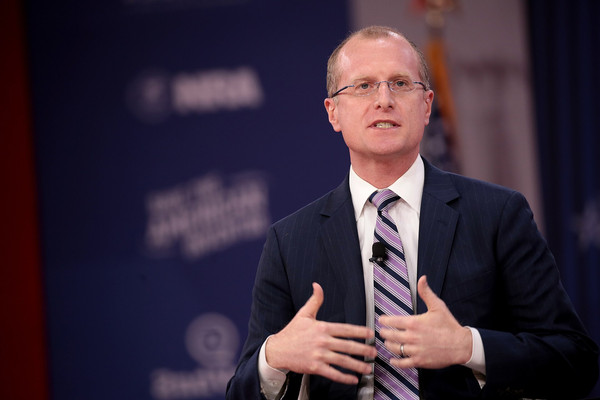
Federal Communications Commission Chairman Brendan Carr was once a member of an Alcoholics Anonymous group in Washington, D.C., that some former members have described as a cult and sexually exploitative, according to a new report.
The Guardian published a lengthy report Wednesday detailing the group, known as Midtown, and alleged behavior by its late leader, Michael Quinones. The report was based on interviews with 14 former members as well as recordings.
Carr was not alleged to have directly taken part in any of the behavior described.
According to the report, Midtown drew in younger people seeking help with addiction, but some former members described it as a "cult." Former female members alleged that the group's grip extended well beyond addiction recovery, imposing strict parameters on their lives and even forcing them into relationships with men who were sometimes decades older.
Carr reportedly joined the group in 1996 at age 17 and remained a member for nine years.
People who knew Carr during that time told the outlet they do not believe he participated in inappropriate behavior. One former member said he provided a "safe respite" in an environment where some teenage girls and young women endured "forced relationships, restrictive diets" and psychological manipulation. That same former member described Carr as sensitive and desperate for the approval of others. Another former member said Carr was "never among" the predators and called him a "victim" of Midtown.
A spokesperson for Carr told the outlet that he "did not engage in any of the allegedly illegal conduct or abusive behavior" referenced, adding that "any suggestion that he knew of the allegedly illegal or abusive conduct you point to would be false."
One former member, identified as Tammy S., called Quinones the "Epstein of AA," a reference to the late child sex predator Jeffrey Epstein. Tammy S. joined the group in 1996 at age 28, when Quinones was in his 50s.
Quinones and others have faced accusations from former members of preying on minors.
Another woman, who allegedly dated Carr and described him as "safe," said relationships between teenage girls and older men were widely known within the group. She said she was 16 and in a relationship with a 55-year-old, adding, "That was just the way things worked there." She said she joined as a teenager and that her diet was strictly supervised.
A former roommate of Carr's said members were made to clean the group leader's home as "acts of service." The person said Midtown was "more like a cult than an AA group," while acknowledging it offered young people an outlet to get sober.
While AA groups typically pair sponsors of the same gender, former members said Midtown paired members of the opposite gender and pressured them into dating or sexual relationships. Members were also allegedly pressured to cut off family and friends and to live with other Midtown members, making it harder to leave.
Former member Mandi Pagliarini described the group as structured "like a pyramid," with old-timers at the top holding power. She alleged that girls were pushed to date certain older men and said she experienced "child trafficking and child violation" during her time there.
The group has drawn scrutiny before. In 2007, after Carr reportedly left, Newsweek published a report on critics calling the group "cultlike," and The Washington Post also detailed allegations from former members.
Multiple former members stressed that Carr was never linked to the abuse. One who served as sponsor to young girls in the group said he was "quite a stand-up guy." Another woman recalled that Carr would sneak her fries while members were eating very little, saying he could have been "severely punished" for it.
FCC Chair Brendan Carr Was Member of DC AA Group Former Members Describe as 'Cult,' Report Says
- by:
- 09.23.20
- Source:
nightlynewslink.com

- 09.23.20
